
For many businesses in Africa, the African Continental Free Trade Area (AfCFTA) is often described in big numbers such as a single African market of more than 1.3 billion people, expanded continent-wide markets and business opportunities and new regional value chains. But for a trader trying to move tea from Kenya to Ghana, furniture from Uganda to Côte d’Ivoire, textiles from Tanzania to Egypt, or manufactured goods from Nigeria to Kenya, the real question is simpler than that, which is “what must I do to benefit?”
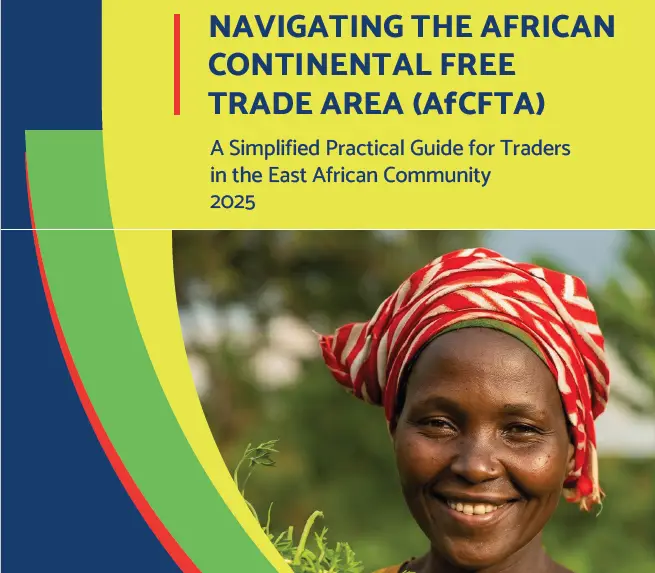
That is the gap the new guide Navigating the AfCFTA – A Simplified Practical Guide for Traders in the East African Community seeks to address. Prepared by TradeMark Africa with knowledge contribution from the East African Community Secretariat, the guide turns a continental trade agreement into a practical tool that businesses can use to explore new markets and value chains across the continent. It explains what the AfCFTA is, who can trade under it, which products may qualify, how tariffs apply, what documents are required, and how traders can obtain a Certificate of Origin.
Understanding the Rules of Origin and Market Access Requirements
“The AfCFTA presents one of the most significant opportunities for African businesses to expand beyond their traditional markets, but opportunities alone do not translate into trade. Businesses can only benefit from preferential tariffs when their goods meet the rules, are properly documented, and fall within the tariff offers of the destination market. At the centre of this are the Rules of Origin, which determine whether a product is considered ‘originating in a qualifying African Member State (State Party’) for purposes of AfCFTA trade,” Benedict Musengele, Director, Trade and Customs at TMA, noted.
A product may qualify if it is wholly produced in a State Party, or if it has been sufficiently generated or processed through value addition, change in tariff heading, specific processing, or by meeting thresholds on non-originating materials.
This matters because simple repackaging, relabelling or minimal processing does not turn an imported product into an AfCFTA-originating product. That distinction can determine whether goods enjoy preferential treatment or face normal tariffs.
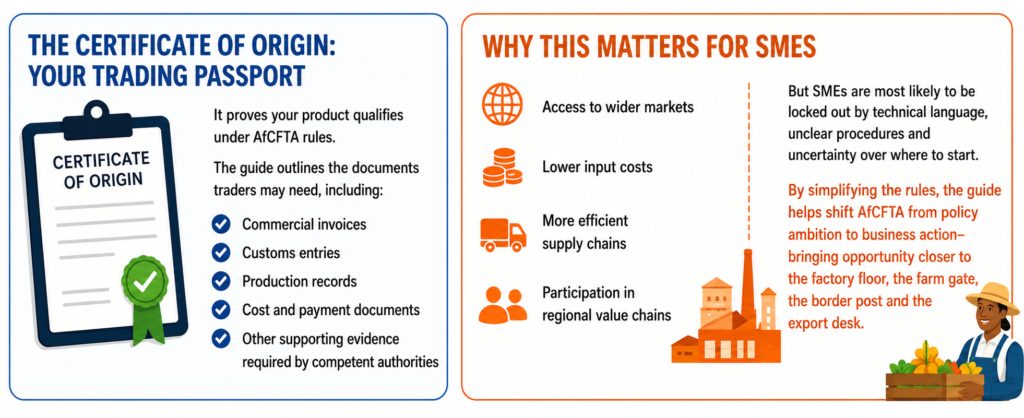
The guide also demystifies the Certificate of Origin, effectively a trading passport that proves a product qualifies under AfCFTA rules. It outlines the documents traders may need, including commercial invoices, customs entries, production records, cost and payment documents, and other supporting evidence required by competent authorities.
Making AfCFTA Work for SMEs
For small and medium-sized enterprises, the guide is timely. AfCFTA promises access to wider markets, lower input costs, more efficient supply chains and participation in regional value chains. But SMEs are also the most likely to be locked out by technical language, unclear procedures and uncertainty over where to start.
By simplifying the rules, the guide helps shift AfCFTA from policy ambition to business action. This guide brings that ambition closer to the factory floor, the farm gate, the border post and the export desk. The message to traders is this. Know your product, check the tariff schedule, confirm the rules of origin, prepare the correct documents, and obtain the required proof of origin before exporting your products. For policymakers and trade support institutions, implementation must be accompanied by hands-on trader education