
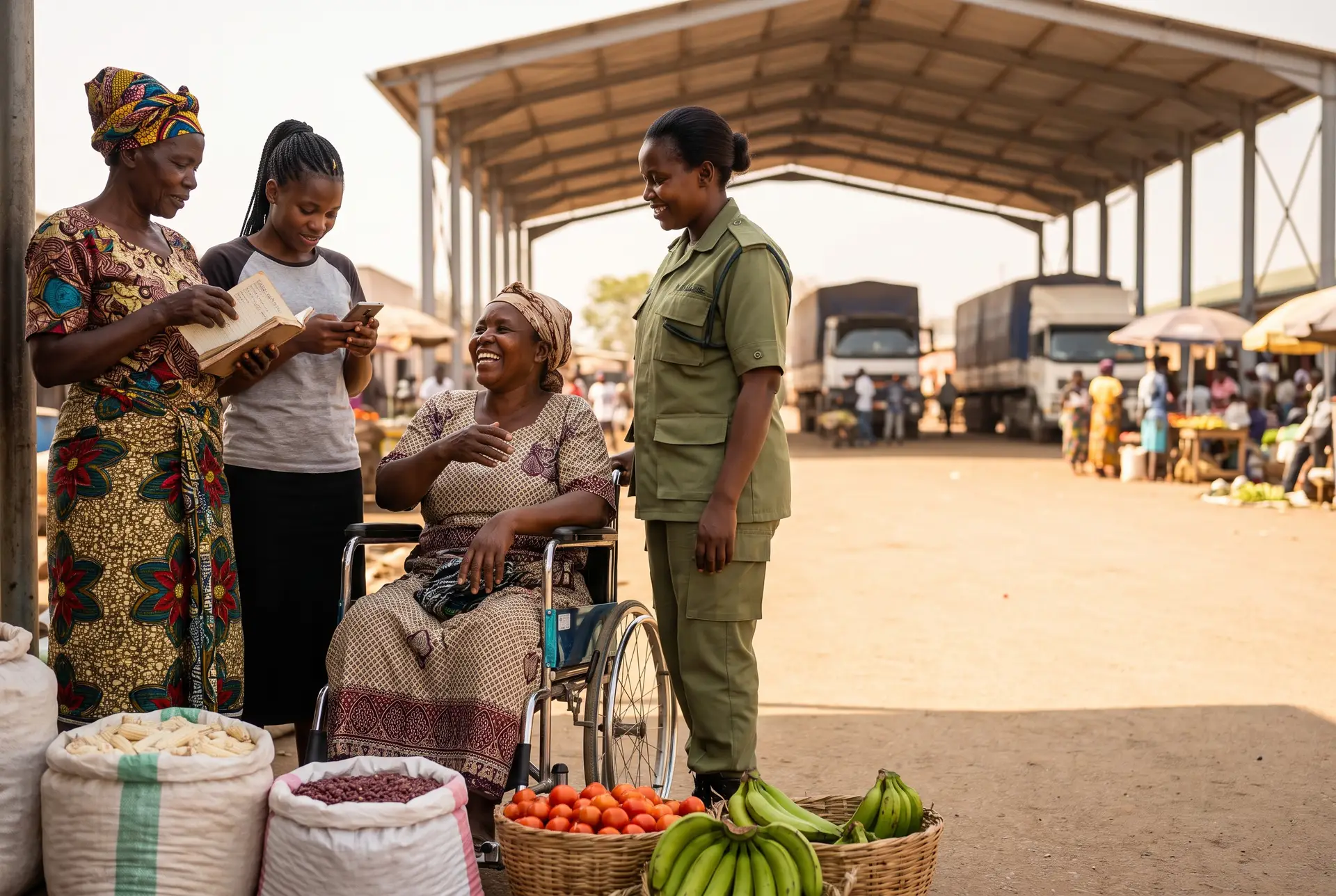
Resilient trade is inclusive trade. Women, youth, persons with disabilities and small-scale traders power Africa’s cross-border commerce, yet they carry the heaviest burden when shocks strike. Costly border procedures, unsafe markets, limited finance, scarce market information and unpaid care work keep them vulnerable. Infrastructure that ignores their needs leaves them behind. Designing with them from the start is how we build trade that can withstand shocks and deliver prosperity for all. As Africa deepens regional integration under the African Continental Free Trade Area, inclusion must become a fundamental part of how trade systems are designed, financed and measured. Critically, lessons from one intervention rarely reach another, and good ideas stay locked inside individual research or implementation projects. Three pressures make acting together urgent: recurring shocks that hit the most vulnerable groups hardest and slowest to recover; falling official development assistance as funders push towards investment; and a backlash against inclusion agendas that puts past gains at risk.
This is why TradeMark Africa launched the Inclusive Trade Community of Practice (CoP) on 30 September 2026 with 246 policymakers, researchers, development partners, businesses, civil society and practitioners. The CoP is a deliberate space to share what is working and what is not towards adoption of the most impactful approaches. The goal is to move beyond counting how many people participate to understanding whether they earn more, build resilient businesses, trade safely and gain greater influence over economic decisions.
This initiative builds on previous Women in Trade programmes at TMA like the Making Trade Work for Women in East Africa project across seven countries, and now the Lagos–Abidjan corridor in West Africa, both funded by Global Affairs Canada (GAC) – a defining partner in this work. Hellen Oriaro of GAC noted how from 2018, its support allowed TMA to target women directly after an independent evaluation showed that early corridor gains had not reached them.
Big “aha” moments: where reflections met and where they pulled apart at the CoP launch
- Intersection: infrastructure is not inclusion. Three vantage points, one lesson. GAC’s evaluation found early corridor gains had not reached women; TMA found one-stop border posts delivered efficiency but displaced informal markets; the Eastern African Sub-Regional Support Initiative for the Advancement of Women (EASSI) described a post built on the ground where women used to trade, fenced, guarded, and staffed by English speakers.
- Intersection: data was everyone’s answer. Donor, researcher, value chain, and civil society voices all returned to the evidence gap. Without it, it is hard to show what works, argue for investment or persuade the private sector.
- Intersection: training alone is not enough. GAC urged pairing training with real market access, the Alliance for a Green Revolution in Africa (AGRA) said the barriers are systemic, and EASSI showed that clusters, cooperatives, and dialogue achieve what individual training cannot.
- Intersection: the care burden surfaced three times. GAC named unpaid care work a structural barrier, EASSI described time and care as a cost at the border, and TMA built a crèche into a market on the Rwanda – Democratic Republic of the Congo border so women could cross and trade.
- Divergence: reach versus empowerment. TMA’s portfolio reached more than 100,000 women traders, yet panelists argued success should now move from counting people reached to measuring empowerment. The CoP must hold both.
- Divergence: different entry points. GAC and AGRA pointed upstream to institutions, higher-value segments (aggregation, processing, logistics, digital services) and tailored finance. EASSI’s quick wins came at the border through trader and official dialogue, such as an $8 pass waived to once every six months. The CoP’s task is to connect these entry points.
The CoP will bridge these gaps, with members identifying shared challenges, testing solutions, comparing results and translating evidence into better policies, programmes and investment decisions. Six priorities will guide the work: user-centred trade systems, enterprise growth, safe and accessible participation, trusted digital trade, stronger trader organisations, and meaningful measurement of empowerment.
The Community will meet twice a year, with the next meeting planned for the end of February 2027. Initial areas of interest include better trade data, digital trade through iSOKO and cross-border payments. Whether you represent government, business, research, development or a traders’ organisation, your experience can help shape this agenda. If you would like to be part of the Community, kindly share your name and email address so we can include you in our mailing list and keep you updated. Contact Benson Mutuku, PhD, through info@trademarkafrica.com.