


Strengthening the Capacity of Women Traders along the Djibouti-Ethiopia Corridor

Implementation Partners
Government of Djibouti and Government of Ethiopia, including the Ministry of Trade and Regional Integration (Ethiopia), Ministry of Women and Social Affairs (Ethiopia) Other Partners: Women's business associations, women traders' associations, private-sector organisations, and other trade-support institutions

Implementation Period
January 2022 - December 2027

Project Participants
Women entrepreneurs, women exporters, women traders, women-owned MSMEs, women traders' associations and corridor stakeholders from Djibouti and Ethiopia.

Funding Partner
European Union (EU)
Project Rationale
Women traders and entrepreneurs contribute to economic activity along the Djibouti-Ethiopia Corridor but continue to face barriers that limit their participation in trade. These include limited access to business and export skills, market information, finance, trade networks and formal trading systems. Such constraints can reduce their ability to benefit from regional and continental market opportunities.
Strengthening women’s participation in trade can expand economic opportunities while supporting household welfare, livelihoods and community resilience. The
project therefore supports women’s economic empowerment while contributing to more inclusive and sustainable trade-led growth.
The intervention contributes to Specific Objective Four: Increased capacity of targeted women traders to participate in trade under the Promoting Regional Economic Integration in the Horn of Africa through the Development of the Djibouti Corridor Programme.
Through capacity development, business-support services, market-access initiatives, support to women traders’ associations and stronger connections with trade-support institutions, the project aims to help women-led enterprises participate more effectively in domestic, regional and continental markets. This includes opportunities arising from the African Continental Free Trade Area (AfCFTA) and corridor-related trade reforms.
Funding Attribution
This project is financed by the EU under Global Gateway and the Team Europe Initiative for the Horn of Africa, with funding delegated to AFD, and implemented by TMA in partnership with the Governments of Djibouti and Ethiopia.
Geographical Focus
Djibouti and Ethiopia, with a particular focus on women traders and women-led businesses operating along the Djibouti-Ethiopia Corridor.
Implementation Strategy
The intervention adopts an integrated approach that addresses the capacity, information, market access and institutional barriers limiting women’s participation in trade. The strategy combines skills development, institutional strengthening, market-access support and policy engagement to enable women traders and women-led enterprises to participate more effectively in domestic, regional and continental markets.
1. Institutional partnerships and stakeholder coordination
The project works with government institutions, women’s associations, business membership organisations, cooperatives and trade-support institutions to strengthen coordination and improve services for women traders. The approach promotes institutional ownership and helps embed support mechanisms within existing national and regional structures.
2. Business and trade capacity development
Targeted training, coaching and practical support strengthen the business, financial and trade capabilities of women traders and women-led enterprises. Areas of support include business management, financial literacy, digital skills, business formalisation, market access, export readiness and understanding of regional trade frameworks, including the AfCFTA.
3. Market access and enterprise competitiveness
The project supports women-led enterprises to strengthen their competitiveness and identify market opportunities through market intelligence, trade-promotion activities, networking and connections with relevant value-chain actors. Where
feasible, the project also supports the identification of commercially viable products and markets.
4. Public-private dialogue and policy engagement
Structured dialogue brings together women traders, public institutions and private sector actors to identify constraints affecting women’s participation in trade and inform practical policy, regulatory and institutional responses. This helps ensure that women’s priorities are considered in trade-related reforms and decision-making.
5. Peer learning, networking and association strengthening
The project strengthens women traders’ associations and facilitates knowledge-sharing, networking and peer-learning opportunities. This is intended to improve access to business information, strengthen collective advocacy and support the sustainability of women-led trade initiatives.
Priorities 2026-2027
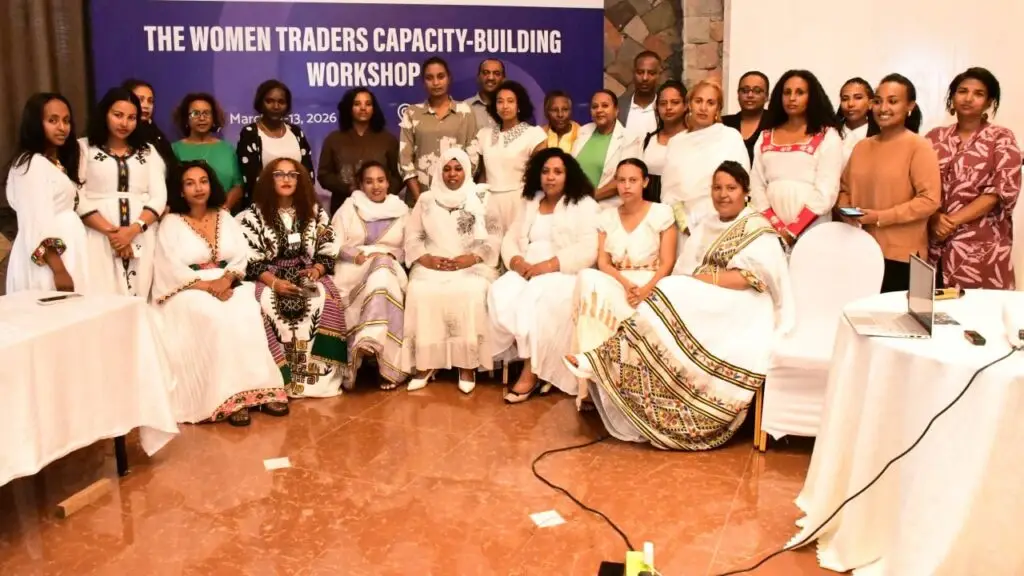
- Expand capacity development for women traders in business management, export readiness, financial literacy, digital skills, regional trade frameworks and market access, informed by training activities in Ethiopia and diagnostic assessments in Djibouti.
- Identify products and value chains with commercial and export potential for women-led enterprises and undertake targeted market assessments to inform business-development and investment decisions. Studies conducted in Djibouti identified potential opportunities in sectors including fish, fruit and vegetables.
- Strengthen market access through trade fairs, business-to-business linkages, networking platforms, export-promotion initiatives and connections with regional buyers and markets.
- Expand public-private dialogue and cross-border coordination to address policy, regulatory and operational barriers affecting women traders
- Support relevant aspects of the AfCFTA Protocol on Women and Youth in Trade.
- Explore the establishment of a women traders’ coordination framework and gender-responsive mechanisms for identifying and addressing non-tariff barriers, subject to approval under the relevant programme governance arrangements.
- Strengthen women traders’ associations and support institutions to improve advocacy, access to information, business-support services and engagement in trade-related reforms.
- Improve women’s access to business-formalisation services, finance, trade-support institutions and regional markets to support the growth and competitiveness of women-led enterprises along the corridor.