

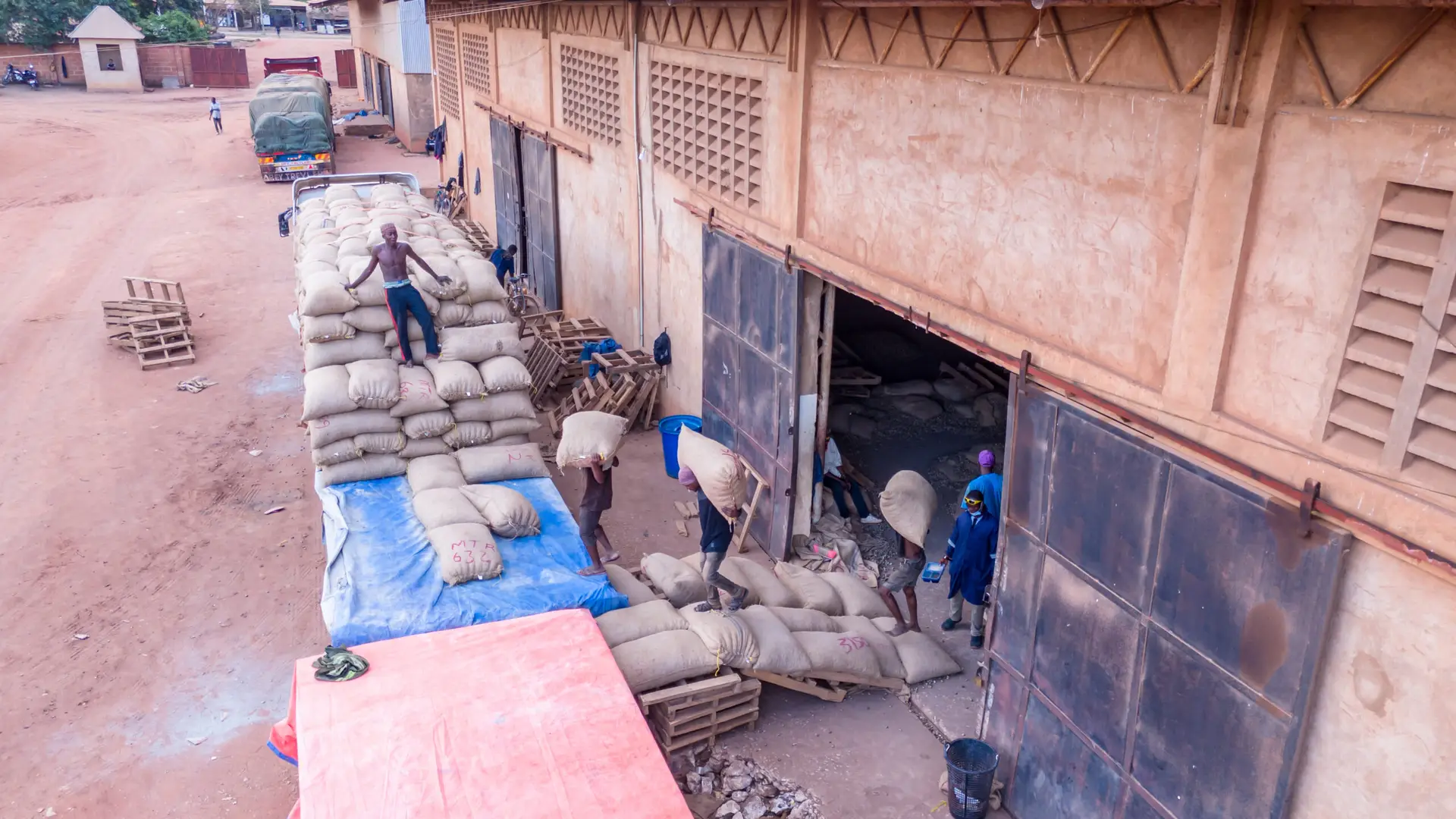
When farmers, traders, and buyers can see prices clearly, trust the system, and transact with confidence, trade becomes more predictable and rewarding for everyone involved. In Tanzania, the Tanzania Mercantile Exchange (TMX) demonstrates how digital trade systems can bring these benefits to market participants by strengthening coordination and supporting export competitiveness across value chains.
TMX provides a structured digital marketplace that supports real-time price discovery, secure transactions, and greater visibility throughout the trading process for producers, cooperatives, traders, and buyers. As a rules-based commodity exchange, TMX brings buyers and sellers into a single platform where quality, pricing and transactions are governed transparently, improving trust and market efficiency.
When market information is accessible, producers can make more informed decisions about when and how to sell, while buyers can participate in trade sessions with clearer visibility of market conditions. This reduces information asymmetry and strengthens price discovery across value chains.
Over time, the platform has expanded to cover a broader range of commodities. TMX has traded sesame, green grams, chickpeas, soybeans, pigeon peas, cashew nuts, cocoa, coffee and tea, and has extended its digital trading model to minerals. This reflects how a single set of market rules can support multiple value chains when systems are designed to scale and integrate different sectors.
TradeMark Africa has supported this work by investing in systems and market readiness, including training and support for platform users. This support is designed to address challenges such as fragmented markets, weak price transparency and limited regulatory oversight, which have traditionally constrained returns for producers.
These interventions are now delivering measurable results. According to the Tanzania Mercantile Exchange Project Report 2025, the value of commodities traded through TMX increased nearly fourfold between FY2023-24 and FY2024-25, from approximately $300 million (TZS 0.7 trillion) to $1.1 billion (TZS 2.7 trillion). This growth was driven by the nationwide expansion of trading in commodities such as sesame, pigeon peas, chickpeas, green grams and cashew nuts. By July 2026, TM200X had facilitated the trade of more than 2.2 million tonnes of commodities valued at $2.38 billion (TZS 6.31 trillion), demonstrating the platform’s continued uptake.
This expansion has been accompanied by improved price outcomes for producers. In FY 2024–25, cashew nut prices traded through TMX peaked at approximately $1.6 (TZS 4,190) per kilogram, representing a 91% increase compared with approximately $0.83 (TZS 2,190) per kilogram in the previous season when traded outside the platform. In the 2024-25 season, cashew sector data showed that around 410,000 tonnes of cashew nuts were sold through the TMX digital auction system, generating about $560.5million (TZS 1.5 trillion) in value, with the platform enabling transparent pricing and competitive bidding. By July 2026, the platform had facilitated the trade of more than 2.2 million tonnes of commodities, valued at approximately $2.4 billion (TZS 6.3 trillion), while cashew prices increased by 91% compared with the previous season.
Earlier trading sessions across other commodities show a similar pattern. In initial TMX trading sessions, chickpeas sold at $0.45 (TZS 1,180) per kilogram compared with $0.26 (TZS 700) per kilogram in informal markets, while sesame prices reached as high as $0.91 (TZS 2,420) per kilogram compared with $0.34–0.45 (TZS 900-1,200) previously. Moreover, cocoa in Morogoro saw a 125% rise in price in the early days when price moved from an average of $0.83 (TZS 2,200) per kilogram through informal channels to average of $1.9 (TZS 4,950) per kilogram when incorporated on TMX online trading platform.
The same systems approach has supported new areas of market activity. Tanzania has reintroduced organised gemstone auctions, including a first auction held in December 2024, supported by electronic trading systems linked to TMX to improve transparency and access to markets.
Digital trade systems are not only about speed. They are about strengthening how markets function by improving predictability, traceability, and coordination. When these conditions are in place, producers and businesses are better positioned to meet market requirements, manage transactions more efficiently, and participate in trade with greater trust and confidence.