

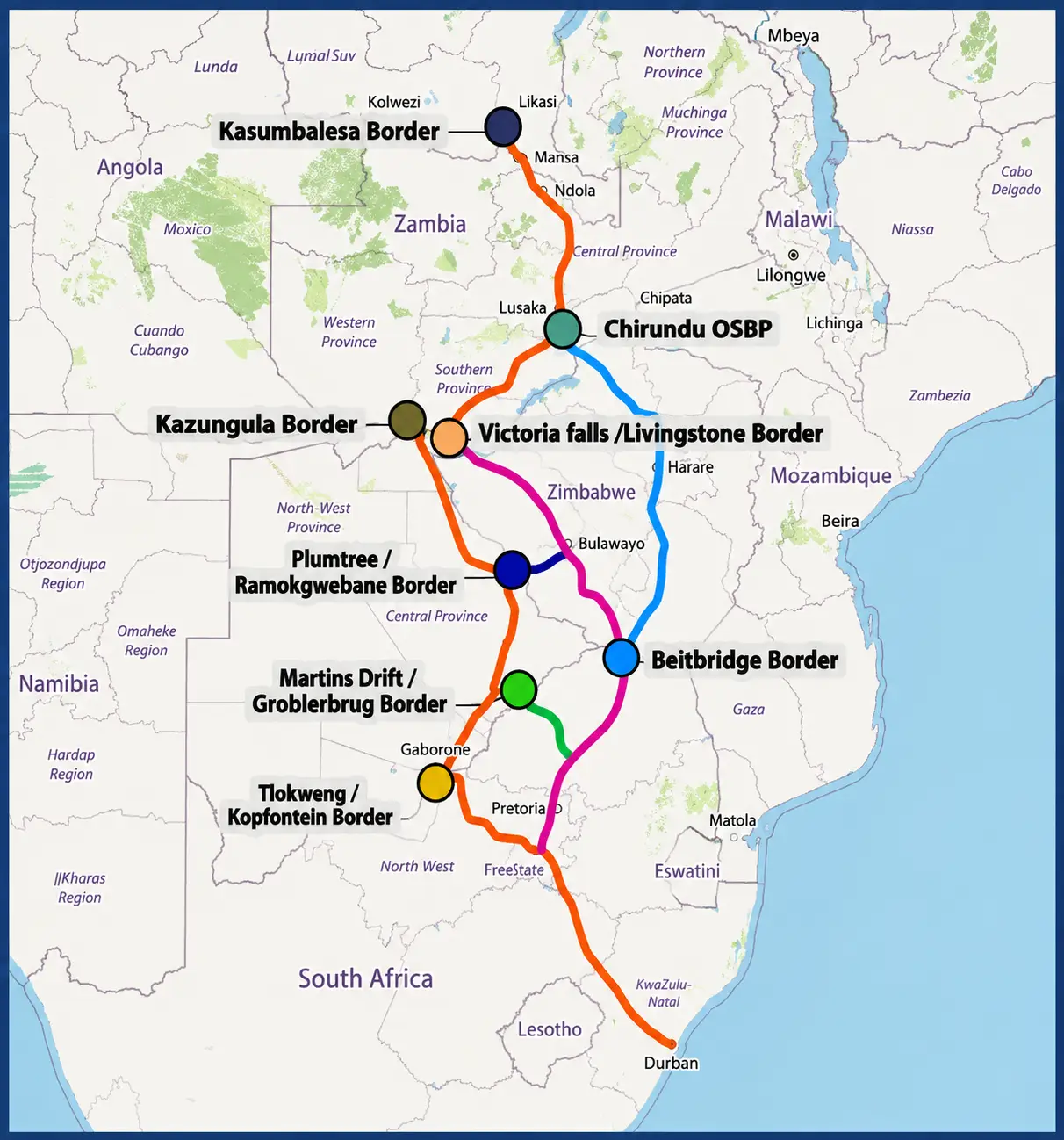
For years, traders moving goods along Southern Africa’s trade corridors have known the symptoms: delayed trucks, unpredictable border crossings, rising logistics costs and missed market opportunities. What has often been missing is a clear, evidence-based data and understanding of where the bottlenecks are occurring and how to fix them. New corridor performance data is beginning to change that.
A data-driven framework supported by TradeMark Africa (TMA) and developed with corridor stakeholders is providing near real-time visibility into how freight moves along the North-South Corridor – the region’s busiest trade route linking the Port of Durban to Botswana, Zimbabwe, Zambia and the Democratic Republic of Congo (DRC). The findings should pique the of stakeholders across the logistics and infrastructure sectors, as articulated in the May 2026 edition of the Road Freight Association’s Truck Talk magazine as well as in the FIDIC Africa Magazine.
Border delays emerging as major pain points
The message from the data is clear: while some parts of the corridor are becoming more efficient, border delays are increasingly undermining overall performance. The analysis identifies a worrying trend across key border crossings. At several points along the corridor, delays are growing, creating uncertainty for transporters and increasing the cost of doing business. Particularly concerning is the Kasumbalesa crossing between Zambia and the DRC, where average crossing times have exceeded 100 hours, according to the TMA commissioned North-South Corridor Performance Monitoring Framework (Turner & Townsend, 2026). Delays are also being observed at Beitbridge, Chirundu and Kazungula, highlighting the need for stronger coordination between border agencies and private sector operators.
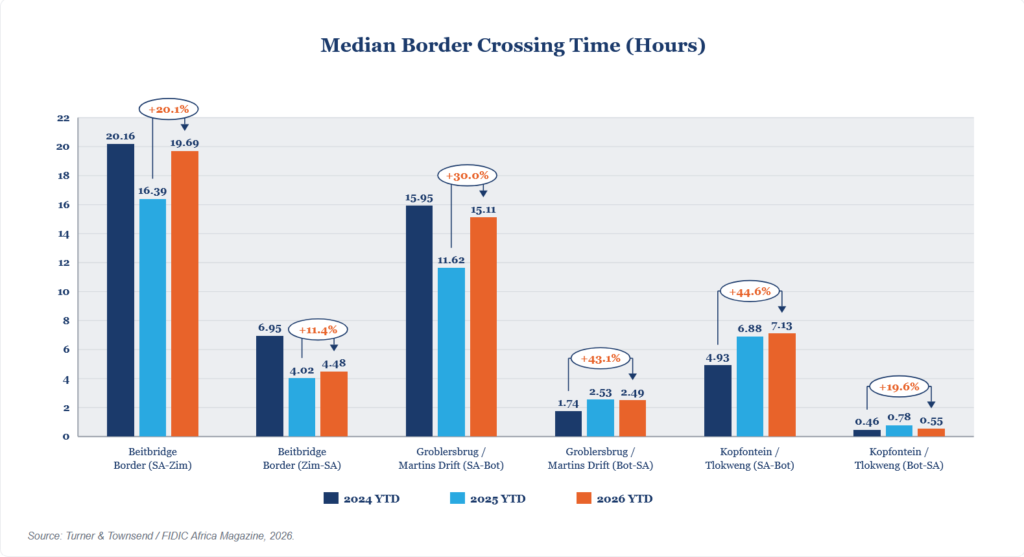
The findings reinforce TMA’s Southern Africa portfolio’s messaging that Southern Africa does not lack trade potential; it suffers from avoidable friction. Border delays, fragmented customs procedures, weak digital interoperability and non-tariff barriers continue to slow trade along some of the region’s most important corridors.
Durban shows what is possible
The data also provides reasons for optimism. Port performance at Durban has improved. Vessel call durations have fallen from 6.75 days in 2024 to 6.68 days in 2026, while heavy motor vehicle terminal processing times have improved by nearly 8%.
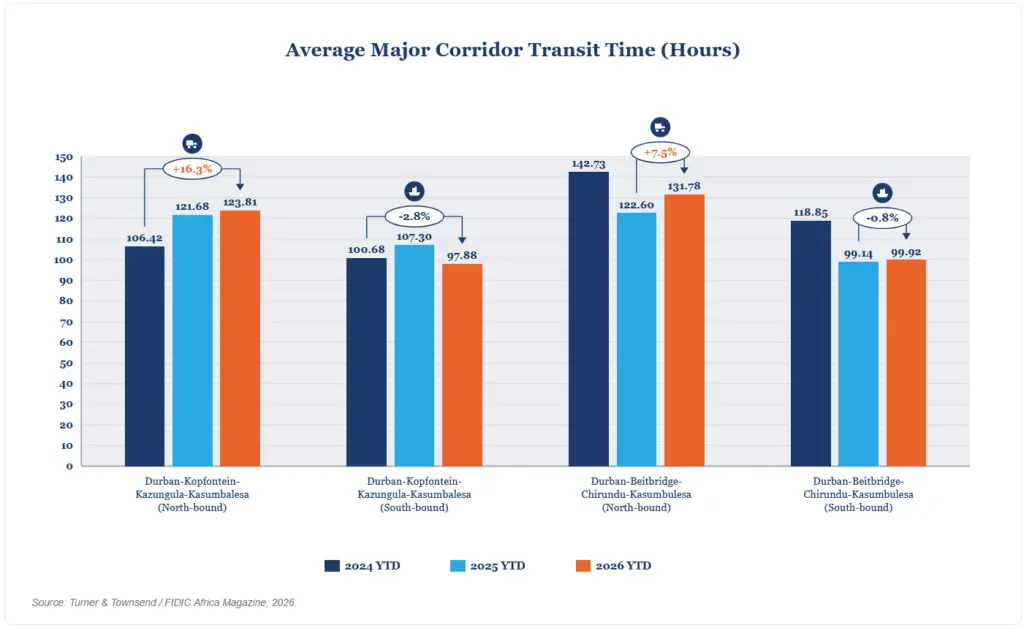
These gains demonstrate that targeted operational reforms can deliver measurable results. Yet the broader lesson is that improvements at ports alone cannot transform corridor performance if trucks continue to face long delays at border crossings further inland. In other words, corridor efficiency is only as strong as its weakest link.
Why TMA is invested in an integrated corridor approach
“The findings closely align with TMA’s Integrated Corridor Approach in Southern Africa, which focuses on addressing constraints across entire trade routes rather than at isolated locations or nodes. The approach recognises that trade corridors are systems linking ports, border posts, customs authorities, testing laboratories, transport operators and digital platforms. Improving one element without addressing the others often limits the overall impact,” TMA’s Senior Director for Trade Environment, Mark Priestley observes.
Across Southern Africa, TMA is working with governments and development partners to reduce the time, cost and unpredictability of trade along the North-South, Beira and Dar es Salaam corridors, while preparing to expand support to the Lobito, Maputo and Walvis Bay corridors. This includes:
- Supporting the modernisation of the Nakonde One Stop Border Post in Zambia (the first phase of the upgrades was commissioned by the President of Zambia, Hakainde Hichilema in March 2026). The target of the upgrades is to reduce clearance times by more than half.
- Advancing customs-to-customs data exchange between Zambia, Malawi, Mozambique and Zimbabwe to enable faster and more predictable clearance processes.
- Supporting digital trade systems such as Mozambique’s e-Phyto platform, which has reduced phytosanitary certification timelines from up to 12 days to just two or three days.
- Supporting the establishment of Joint Border Committees, including at Forbes-Machipanda, to improve cross-border coordination.
- Developing corridor monitoring tools and observatories that provide governments and businesses with actionable performance data.
From data to decisions
Perhaps the most important contribution of the framework is that it shifts corridor management from anecdote to evidence. By combining GPS freight movement data, vessel tracking information and border performance metrics, policymakers can identify precisely where delays occur, measure the effectiveness of reforms and prioritise investments with greater confidence.
The data also points to practical solutions. Improved border coordination, stronger compliance with customs procedures, wider adoption of digital systems and better operational alignment between public and private sector actors could significantly reduce delays across the corridor.