
A green trade agenda in Africa is not just rhetorical. African countries are increasingly shaping their trade policy to align with the growing interface between trade and environmental sustainability. This is evident by a number of continental “greening” strategy documents, which include the African Union’s (AU) African Green Minerals Strategy and Green Recovery Action Plan as well as the African Development Bank’s Green Growth Agenda. African states are at the forefront of enacting policies that align with this growing interface.
The question, therefore, is not whether Africa should engage in the global shift towards “trade and sustainability,” but how to do so on terms that support industrialization, job creation, and structural transformation.
Placing Green Transport Corridors at the Centre of Africa’s Future Trade Competitiveness and Resilience.
To respond to the shift in the interface, TradeMark Africa has developed a strategy that places green transport corridors at the centre of Africa’s future trade competitiveness and resilience. This reflects a growing recognition that climate change is now a core trade and market access issue affecting production, logistics costs, export competitiveness, and access to increasingly sustainability-conscious global markets.
The cornerstone of this strategy is threefold.
First, TradeMark Africa supports emissions reduction across trade transport and logistics systems. Through investments in port and border efficiency, digitization of trade processes, integrated corridor management, smart borders, and trade facilitation, the organization helps reduce cargo delays, congestion, and fuel consumption while lowering trade costs. TradeMark Africa is also increasingly supporting dialogue and partnerships around green ports, climate-resilient corridor infrastructure, and sustainable logistics systems.
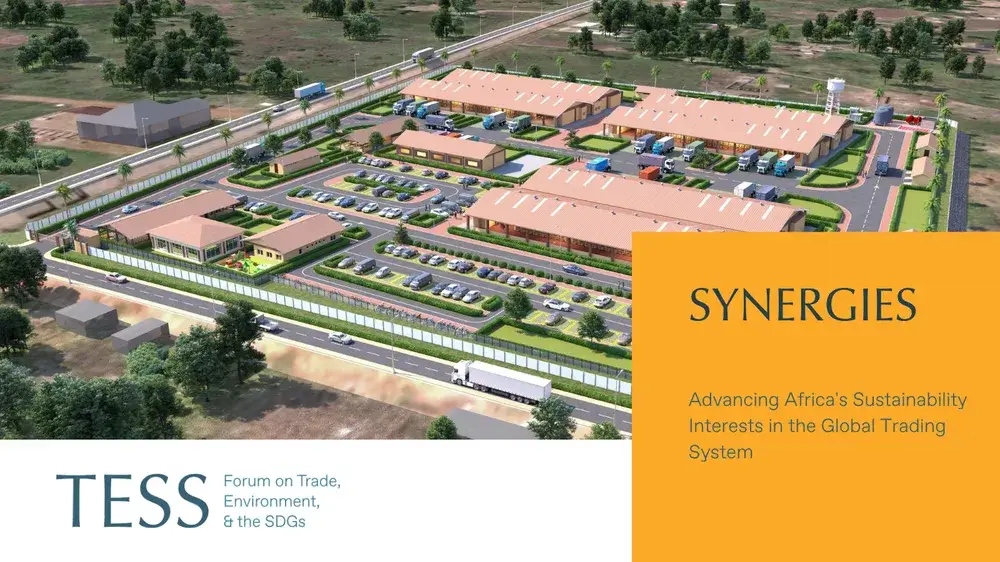
Second, the strategy strengthens the resilience and adaptive capacity of trading communities, particularly women cross-border traders, SMEs, and informal traders that are highly vulnerable to climate disruptions. Through climate-sensitive border infrastructure, TradeMark Africa supports more resilient and inclusive trade systems. In 2025, for instance, we broke ground on construction of the first climate-resilient cross-border market at Elegu—a Uganda/South Sudan border town. Elegu is a strategic trade gateway and Uganda’s third-largest informal export corridor; and hence where trade resilience will be of significant boost to Uganda’s national trade.
Third, we support a gradual export shift from high-emission air freight towards more sustainable sea freight systems where commercially viable. Through initiatives such as the Business Environment and Export Enhancement Programme, the organization is supporting lower-carbon export logistics aligned to emerging sustainability expectations in major export markets.
Scaling Proven Interventions and Positioning African Export Growth for Emerging Market Opportunities
On prospects of a successful fusion between trade and sustainability, Africa’s next phase of export growth will depend on how effectively it combines technology, scales proven interventions, and positions itself for emerging market opportunities.Technology is central because it can reduce the high costs that continue to weaken competitiveness across the continent, from inefficient logistics and fragmented supply chains to limited market information and compliance challenges.
In Ethiopia, for example, we are supporting government to roll out an EV technologies for road transport, using digital logistics platforms and emissions monitoring systems, and supporting freight transport emission reduction along the Djibouti and Berbera corridors. At the same time, Africa does not need to start from scratch; it should expand successful interventions that have already demonstrated practical value.
Programmes on Airfreight-to-Seafreight for example have seen Kenya become the leading African exporter of avocadoes, with 80% of exports of the fruit being sea freighted. Similarly, the story on Africa’s coffee exports remains promising. In 2023, Saudi Arabia became the largest importer of Ethiopian coffee, overtaking the US and Germany as traditional main coffee export markets.
Africa must look boldly at new and expanding markets where demand is rising and trade conditions are becoming more favourable.
Scaling such models across sectors and countries would help enhance production complexity and reduce emissions, while responding to shifting consumer preferences in import markets. Africa must look boldly at new and expanding markets where demand is rising and trade conditions are becoming more favourable.
Fostering Practical Partnerships That Make Technology Accessible, Affordable, and Usable for Africa
To achieve broad trade-sustainability interface, the strategy must be built around practical partnerships that make technology accessible, affordable, and usable for African producers, exporters, and institutions. Adoption does not happen simply because a solution exists; it happens when firms adopt it. This means governments, development partners, private investors, research institutions, and industry associations need to work together to lower entry barriers and expand access to technologies that contribute to lowering emissions.
Similarly, the policy environment must be shaped in a way that supports transition rather than exclusion. As new sustainability regulations emerge in global markets, there is a strong case for engaging trading partners to create more realistic pathways for compliance, especially for countries and firms that still face major capacity constraints in Africa. The objective should not be to weaken standards, but to secure implementation approaches that recognize different starting points and provide sufficient space for adaptation. This includes longer adjustment periods, stronger technical assistance, investment in certification systems, and support for upgrading production processes so that compliance becomes achievable in practice. Without such flexibility, sustainability rules risk becoming new barriers to trade rather than instruments for improving competitiveness and resilience.
Africa should combine partnership-driven technology adoption with a more development-oriented approach to sustainability compliance.
If Africa combines partnership-driven technology adoption with a more development-oriented approach to sustainability compliance, it will be better positioned to scale successful interventions, integrate more firms into value chains, and compete effectively in high-growth destinations. In this way, adoption becomes not just a technical exercise, but a strategic pathway to stronger market access, higher value exports, and inclusive transformation across the continent.
Building a Unified, Formalized Continental Voice on Trade and Sustainability
As Africa continues to engage on trade-sustainability interface, a long-term objective should be to build a unified, formalized continental voice on trade and sustainability. This means continuously building African capacity to participate early in standard-setting, to demand transparency and proportionality in new measures, and to negotiate pathways that recognize different starting points for different countries.
Over time, this requires dedicated African institutions and processes that can translate African realities into negotiating mandates that align trade ministries with environment, agriculture, and industry and sustain a disciplined external message across the African Union, the African Continental Free Trade Area, and African groupings in the WTO. Without a unified voice, African countries risk reacting individually to major partners’ policies rather than shaping them collectively.
Author: Allen Sophia Asiimwe (Deputy CEO & Chief of Programmes, TradeMark Africa.)
Read the original article at: Advancing Africa’s Sustainability Interests in the Global Trading System