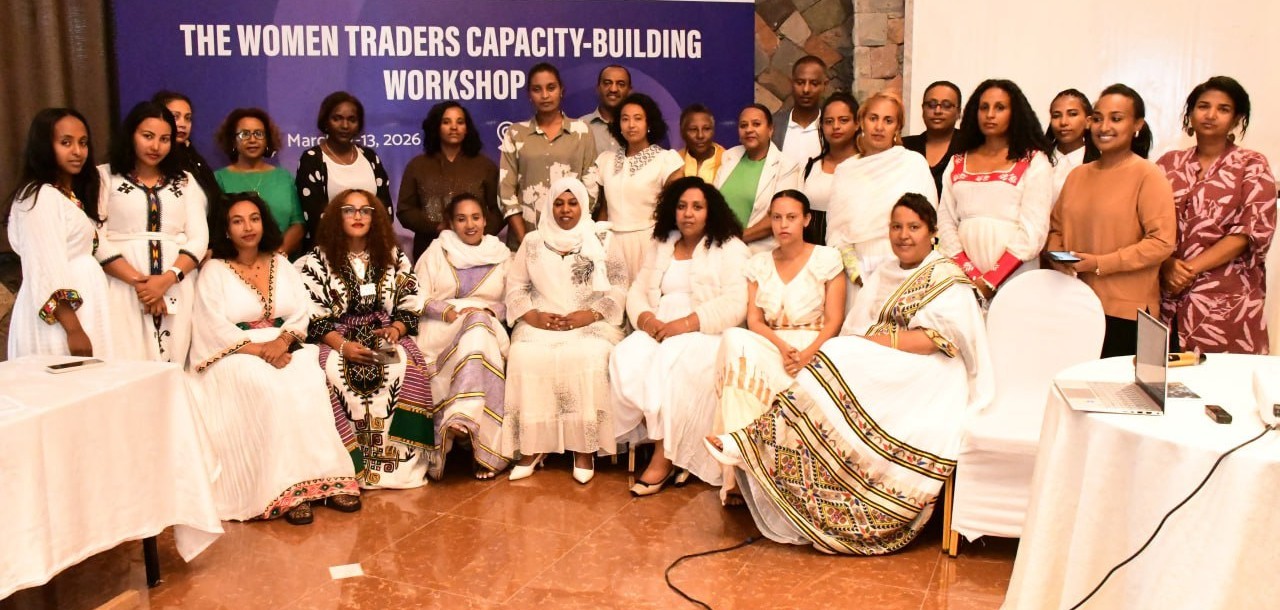
Bishoftu, Ethiopia, 12 March 2026: Thirty women exporters from Addis Ababa, Oromia, and Amhara have completed a targeted training initiative under the European Union-funded Djibouti Corridor Programme, channelled through Agence Française de Développement (AFD), aimed at strengthening their participation in formal regional trade.
Delivered in collaboration with the Ministry of Trade and Regional Integration (MoTRI) and TradeMark Africa, the initiative coincided with International Women’s Month 2026 under the theme Give to Gain, highlighting the economic and social returns of investing in women’s participation in trade. Participants received practical training on export documentation and preferential market access frameworks, including the COMESA Simplified Trade Regime (STR) and the African Continental Free Trade Area (AfCFTA). The training also introduced traders to Ethiopia’s bilateral trade cooperation agreements and cross-border trade frameworks, as well as corridor-based arrangements such as the Ethiopia-Djibouti Customs Transit Protocol, which facilitates the movement of goods through Djibouti, Ethiopia’s principal maritime gateway. The objective was to support business formalisation and enable women-led enterprises to participate more effectively in regional markets and cross-border value chains.
The initiative forms part of the European Union’s €32m investment in the Djibouti Corridor Programme, delivered under the Global Gateway and Team Europe frameworks. The programme supports trade facilitation reforms, corridor governance and inclusive economic participation along Ethiopia’s principal trade route to the Port of Djibouti.
The programme seeks to tackle the persistent exclusion of women and other vulnerable groups from cross-border trade and opportunities of export markets, recognising that these communities often face significant barriers such as limited access to resources, discriminatory policies, and socio-economic challenges. A gender situational analysis commissioned under it found that 94% of women cross-border traders along the corridor operate without business licences, and more than one in three report making informal payments at border crossings.
The workshop comes as Ethiopia deepens its trade relationships -EU-Ethiopia trade reached €2.2 billion in 2023, Ethiopia has signed 28 bilateral trade agreements, and duty-free trade under AfCFTA was activated in October 2025.
H.E. State Minister of Trade and Regional Integration, Mrs Yasmin Wohabrebbi, said trade policy reforms must translate into practical opportunities for traders operating along regional corridors, stating: “Ethiopia has expanded its trade partnerships and strengthened its market access frameworks. The priority now is ensuring that the traders who sustain cross-border commerce can participate in these opportunities. Strengthening women traders’ understanding of trade procedures allows them to operate within formal systems and benefit from the agreements the country has negotiated.”
The advisor of the State Minister of Women and Social Affairs, Mr Solomon Asfaw said: “Women traders support household incomes and local markets across the region. Ensuring that they have access to knowledge, legal frameworks and institutional support strengthens both economic inclusion and community resilience.”
Ewnetu Taye, TradeMark Africa’s Ethiopia Country Director, said: “When institutions invest in knowledge, systems and cooperation, traders gain the tools needed to participate fully in regional markets. Strengthening the capacity of women traders contributes directly to the efficiency and inclusiveness of the Djibouti-Ethiopia corridor.”
The training also supports reforms coordinated through the Joint Ethiopia-Djibouti National Oversight Committee. For participating traders, improved understanding of customs procedures, duty-free regimes and business formalisation processes will enable more effective engagement in regional markets as Ethiopia deepens its integration into continental and global trade systems.