Roads
Many of the early gains in TMA’s trade facilitation portfolio came from investments in physical infrastructure – Ports, Roads, Borders. Notably, there was a significant reduction in dwell times at Mombasa port from 21 to 3.5 days between 2011 and 2021. Additionally, there were substantial reductions in border crossing times, which improved market access by facilitating the physical movement of goods. In this context, market access refers to the ability of goods to reach markets, with transport being a critical factor. The cost of this access directly affects the overall price of goods. According to UNCTAD, poor connectivity in Africa has led to road transport costs accounting for about 29% of the price of goods traded within the continent, compared to just 7% for goods traded outside Africa. This makes goods within the continent more expensive and less competitive in global markets. One of the primary factors contributing to these high transport costs is inadequate infrastructure that fails to meet both current and future traffic demands, resulting in congestion and delays.
Even when the physical infrastructure itself is adequate, inefficiencies in asset usage can cause unnecessary delays. Factors include low labour productivity, bureaucratic inefficiency, poor transport regulation, and corruption. As evidence of the broader issue, the 2024 World Bank Container Port Performance Index indicates that sub-Saharan African ports rank among the lowest globally in terms of efficiency and overall performance.
In response to these challenges, TMA’s approach to transport infrastructure development is designed to maximize the impact of its interventions. This is achieved by leveraging TMA’s strengths: its substantial footprint across East, Horn, and West Africa, its thematic focus on reducing trade costs and time, and its institutional agility. However, the resources available for infrastructure development have decreased, despite the persistent and significant trade infrastructure gap. The scale of the financing challenge is stark. The African Development Bank estimates that Africa needs to invest $130-170 billion annually in infrastructure, yet there is a financing gap of $68-108 billion. The Programme for Infrastructure Development in Africa (PIDA) projects that $360 billion will be required by 2040 to support the continent’s developmental goals, particularly in trade and transport.
Commercial Development
The reduction in traditional budgetary support from governments and donors necessitates exploring new models to access commercial and semi-commercial capital. TMA therefore created Trade Catalyst Africa (TCA) as a catalytic capital facility, to pilot new commercial models for creating trade infrastructure.

Grant-Based Model
For projects that are not commercially viable but are essential for regional integration and trade for peace, TMA will continue to use its grant-based funding model.
Hybrid Model
For projects that are marginally viable TMA will provide viability grant funding in a manner that the project parameters can then become sufficiently attractive to leverage funding from other sources.
2010-2024
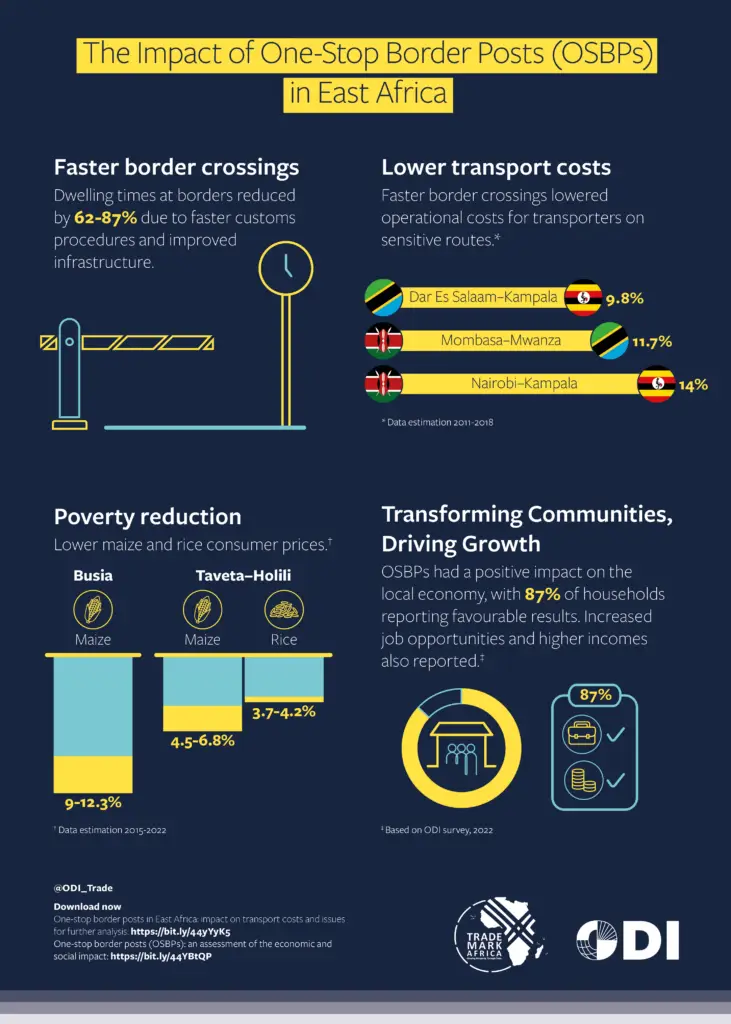
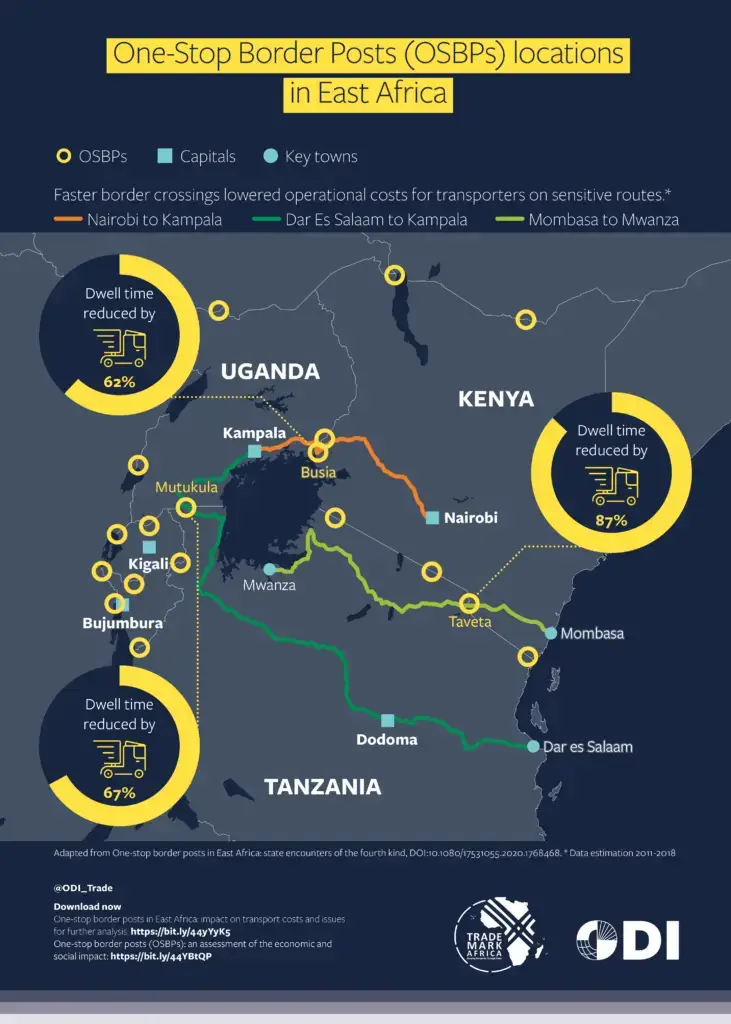
Over 20 One Stop Border Posts constructed or operationalised across Eastern and Horn of Africa. Time to cross select OSBP’s reduced by an average of 70%. TMA supported construction and operationalisation of 15 OSBPs across the EAC region.
Time to transport a 20-foot container from Mombasa to Kampala reduced from 4.5 in 2017 days to 3.1 days in 2021 according to the Northern Corridor Transport Observatory, April 2022.
38% reduction in travel time on the completed Hargeisa Bypass in Somaliland from 10.3 hours before construction to 6.3 hours in 2023 (TMA final project report)
Interventions at Mombasa Port have contributed to reduced cargo dwell time from 7.2 in 2012 days to 3.5 days in 2022; resultantly, cargo through the port had an annual compounded growth of 5.7% from 27 million metric tonnes to 34 million metric tonnes within the same period; with container traffic at 5.6%, from 1.09 million Twenty-Feet Equivalent units (TUEs) to 1.36 million TEUs (Northern Corridor Transport Observatory, April 2022)
182 hours saved in travel time per vehicle over a year based on 54% decrease in travel time from 55 minutes in 2019 to 30 minutes in 2023 on average for Mombasa roads (Kipevu Road, Magongo Road- A109, Mbaraki and Port Reitz/Airport Road)